We Build AI That Refuses to Do the Work: Ethics, Engineered Into Study Tools
The easiest thing to build in ed-tech is a machine that writes the paper. The most defensible thing is to refuse. Here is how our verification discipline looks pointed at study tools for real college courses.

The easiest thing to build in education technology is a machine that writes the paper for you. It is also the most defensible thing to refuse. We build AI that is made to prove its work — and in a domain where the customer would happily let the tool do the cheating for them, that discipline is the entire product. Here is how the same standard looks pointed at a study tool built for real college courses.
Help the student; never do the work
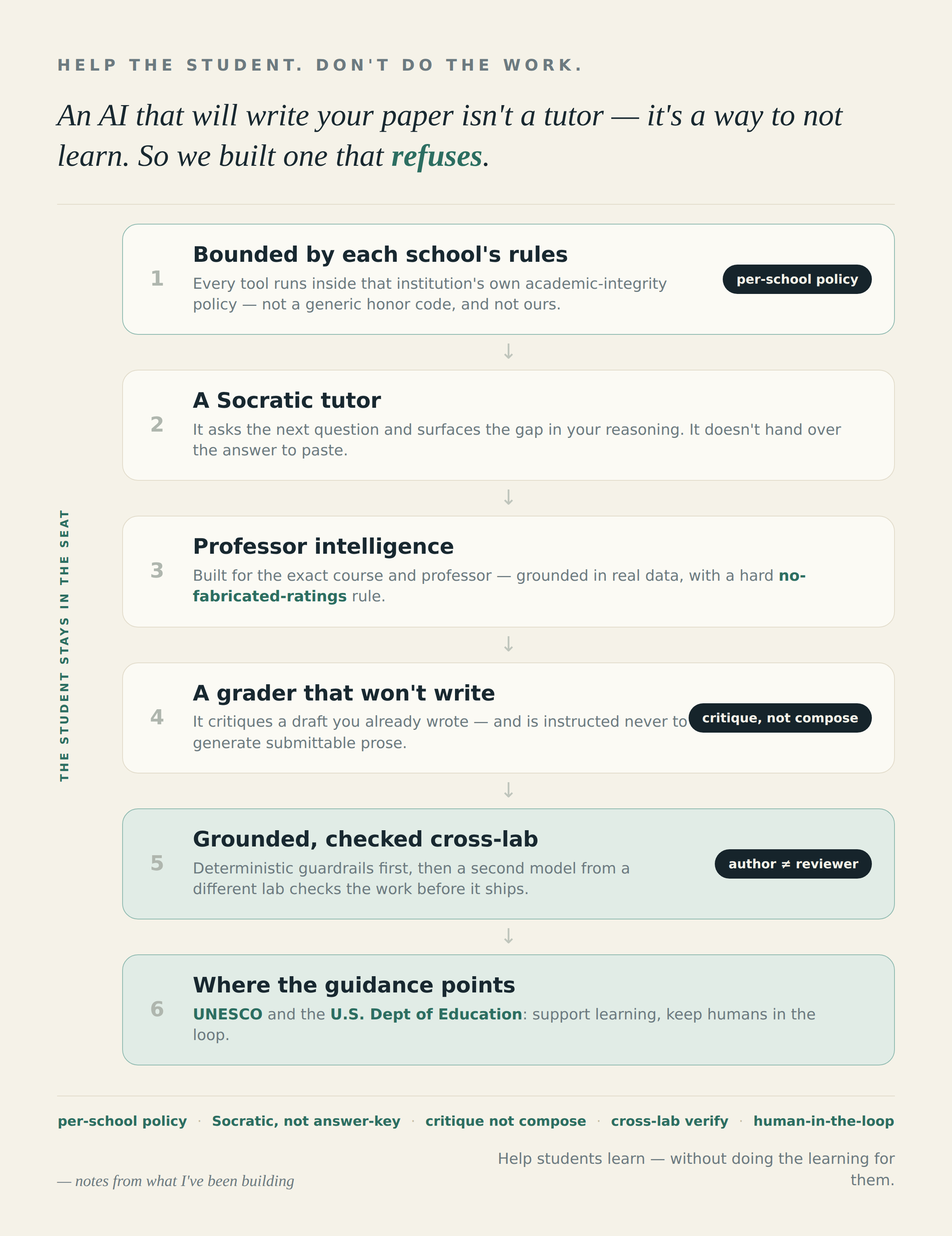
The line is simple to state and hard to engineer: the tool helps a student learn and never does the learning for them. The study tools are built for a student's exact course and professor, grounded in real course and professor data with a strict no-fabricated-ratings rule — if the data is not real, it is not invented. The tutor is Socratic by design: it asks the next question and surfaces the gap, rather than handing over an answer to paste. And the essay tool assesses only writing the student has already produced — built to critique a draft, instructed never to generate submittable prose. It grades; it does not ghostwrite.
Bounded by each institution's own policy
Every tool runs inside the academic-integrity policy of the specific school it serves — not a generic honor code, and not our opinion of what is fair. What counts as permitted help is the institution's call; the tool's job is to honor it. That is a deliberate transfer of authority, and it is what makes the product safe to put in front of a university.
Grounded, and checked by a different lab
None of it matters if the tool is confidently wrong, so every surface is grounded in a real corpus and checked before it ships: deterministic guardrails first — answer key, required format, a denylist of retired guidance — then an independent model, from a different lab than the one that generated the content, judging whether it holds up. The author never grades its own work. A study tool that hallucinates is worse than none, because the student cannot tell.
Where the guidance points
This is not a house opinion. UNESCO's guidance for generative AI in education is human-centered by design — protect human agency, support learning rather than replace it, validate tools before deployment — and the US Department of Education's AI in teaching and learning report lands on keeping humans in the loop. We build to that standard because the alternative — a tool that quietly makes its users worse at the thing they are paying to learn — is not a product we will ship.
The full write-up lives on jessemyers.ai.